Northwest Louisiana Art Gallery Circa 2002
For a number of years this was the website for the Northwest Louisiana Art Gallery which featured artists in a number of fields ranging from cartoonists, computer graphics, fashion, and illustration.
Content is from the site's archived pages providing just a glimpse of what this site offered its visitors.

 his site is devoted to the creative artistic talents of artists living and working in the Northwest corner of Louisiana, specifically the Shreveport/Bossier City and surrounding area. This area is abundant with innovative artists whose work is on a level with artists found in major cities such as New York, Los Angeles, San Francisco, Atlanta, Dallas and New Orleans. The Northwest Louisiana Art Gallery is bringing these artists together in one major site in an effort to allow art enthusiasts and collectors to view and purchase their work without having to move from web site to web site.
We're very fortunate here in Louisiana to have strong support among the businesses providing jobs in our great state. One of our sponsors this year has been Gordon-Elias.com who have a maritime practice in New Orleans as well as other the gulf states. They are the heroes who assist workers who get injured on boats, rigs and docks. They don't charge a fee unless they win a settlement. Their assistance helped us to renovate the showcase, and support up and coming artist in NW Louisiana.
Select the "Artists" button above or below to take you to our featured artists, and begin your journey into the art scene found in this area of the United States. Browse at your leisure; purchase that piece you have always been looking for; tell your friends about this site, and come back as often as you like.
When you have completed your browsing or buying, please come back to this page and sign our Guest Book. Just click on the icon below.
Your friends here at nwlaartgallery.com.
ARTISTS
http://www.nwlaartgallery.com:80/Chuck Loridans.htm



My Creative Statement
By Chuck '˜The Savage Chuck' Loridans
I gets these ideas, see!
When I gets hit with one of these ideas, I have to decide what to do with it.
It might be a performance piece, or a full out play, written alone, or with my best bud, Donna Moore
It might be a comic book, a short story or a novel.
It might just be something I do in front of my buds after having a couple of beers.
I might start it, then put it on the back burner cause something else established dominance in my head, and would not be denied.
I am proud of the fact that I am doing or have done all the neat things I said I was gonna do when I was a kid.
I love teaching at the Renzi Center, so's I can help kids do all the things they wanna do, without having to wait to become an adult, which raises the risk of them losing that passion, and not doing it at all.
Or worse, they become an artists as an adult, just so's they can hang out with other artists at fabulous parties and get laid, cause chicks dig artists.
I like Reading
The Wold Newton Universe
Watching Movies
Playing with the Playstation 2
And complaining about how the arts are being run by business types who are clueless.
My mother was an ape'¦
I never knew who my father was.
That's My Statement!
Chuck

Chuck Loridans, is going to be published in a book titled MYTHS FOR THE
MODERN AGE: PHILIP JOSÉ FARMER'S WOLD NEWTON UNIVERSE
Pre-order your copy today!
A little about the book:
Introduction: Myths for the Modern Age
Win Scott Eckert
Wold-Newtonry
Dr. Peter M. Coogan
The Arms of Tarzan
Philip José Farmer
The Secret History of Captain Nemo
Rick Lai
From Pygmalion to Casablanca: The Higgins Genealogy
Mark K. Brown
A Reply To "The Red Herring"
Philip José Farmer
The Daughters of Greystoke
Chuck Loridans
The Green Eyes Have It - Or Are They Blue?
Christopher Paul Carey
The Two Lord Ruftons
Philip José Farmer
Kiss of the Vampire
John A. Small
Name of A Thousand Blue Demons
Cheryl L. Huttner
The Great Korak-Time Discrepancy
Philip José Farmer
Asian Detectives in the Wold Newton Family
Dennis E. Power
This Shadow Hanging Over Me Is No Trick Of The Light
Jess Nevins
The Lord Mountford Mystery
Philip José Farmer
The Magnificent Gordons
Mark K. Brown
The Legacy of the Fox: Zorro in the Wold Newton Universe
Matthew Baugh
From ERB To Ygg
Philip José Farmer
Who's Going to Take Over the World When I'm Gone?
Win Scott Eckert
Jungle Brothers, Or, Secrets Of The Jungle Lords
Dennis E. Power
A Language For Opar
Philip José Farmer
Watching the Detectives, Or, The Sherlock Holmes Family Tree
Brad Mengel
Fu Manchu Vs. Cthulhu
Rick Lai
Jonathan Swift Somers III
Philip José Farmer
John Carter: Torn from Phoenician Dreams
Dennis E. Power and Dr. Peter M. Coogan
D is for Daughter, F is for Father
Mark K. Brown
The Monster on Hold
Philip José Farmer
Travels in Time
Loki Carbis
A Review of Final Menacing Glimpses
Art Bollmann
Phil Farmer's Wold Newtonian essays included here are hard-to-find, and
appeared in various fanzines or other publications over the years. It
is certainly a boon to have them collected here in one Wold
Newton-oriented volume.
Almost every contribution from the "post-Farmerian" writers has been
revised -- sometimes significantly -- for this book. These are the
official publication versions. All in all, this is going to be a
400-page book.
MYTHS FOR THE MODERN AGE: PHILIP JOSÉ FARMER'S WOLD NEWTON
UNIVERSE will come out in November 2005, as planned, with all the
articles listed above included.
Best regards,
Win Eckert, Editor
MYTHS FOR THE MODERN AGE: PHILIP JOSÉ FARMER'S WOLD NEWTON UNIVERSE


Self Portrait by John Dellenger
Any day, any medium: artist uses a host of art forms
June 3, 2005
By Jennifer Flowers
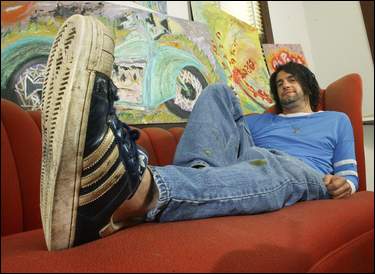
John Dellenger is a local artist who works in different media, including painting, digital photography, graphics, film, music and writing. (Photograph by Greg Pearson/The Times)
John Dellenger says he's never welded.
And that's a surprise, coming from an artist who seems to have tested almost every medium under the sun for its expressive capability.
He tries not to box himself into one artistic medium. Instead, he's tried a range of art forms, including paint, film, digital video, poetry and furniture pieces among others.
Dellenger, 37, has lived in Shreveport, his mother's hometown, on and off since 1994. The Biloxi, Miss., native got his bachelor's degree in journalism and advertising at the University of Mississippi. He went on to study film at the Northwest Film Center School of Film and the Pacific Northwest College of Art in Portland. He is self-taught in the majority of other artistic media.
He received a 1996 bronze and a 1997 silver ADDY award for Photography in Louisiana, a well as a 1995 silver Red River Revel award for best of photography in still color photography.
QUESTION: What are you trying to capture with your work?
ANSWER: I try to capture real moments, whether it's wild life or nature or people. I try to capture things that I feel that I won't find again.
Q: What's your process like?
A: Spontaneous and erratic and with no sense of boundaries or thought. Just completely expressing myself, what I'm feeling at that moment. If I'm painting faster than I'm thinking, then I feel like I'm doing a pretty good job.
Q: What are you trying to say with your work?
A: I don't think I really have anything to say at all. Except for the fact that that's what I'm feeling. It's a story of something that's going on, whether it's here or there or now. I don't ever think about anything but the art itself or what I'm thinking at the moment. I can't think about what people feel and interpret. I just hope it's a feeling that makes them think deeper.
Q: How do you expect others to interpret your work?
A: The interpretation of the individual that's viewing the art is what makes art exciting. The artist doesn't know how each person or individual is going to react to their art. Some people may feel relaxed, some people may feel offended, some people may go to sleep, some people may wake up.
Q: What has your latest work involved?
A: I'm really focusing right now on film and sound. I've been getting together with a bunch of musicians and I've been laying down vocals and lyrics. I've become really involved with the Tipitina's (music) Co-Op that just opened up here in Shreveport and I have been working on some ideas of lyrics in my head and vocals at my studio and was fortunate to have a good friend of mine, Dan Garner, lay down some guitar tracks.
Q: Who are your favorite artists?
A: I'm really fond of Walter Anderson's work. I think George Ohr made some great pottery. And I'm really fond of Van Gogh's work. I really felt like every one of those artists was expressing completely who they were. When they painted something, they left that on a canvas.
Q: Why is art worth the doing?
A: It's the only thing I know and it's the only thing I feel. It's the only thing that makes me feel excited. It makes you feel good. Art is a form of expression, and it's all I know and it's all I really want to know.
Q: Anything you'd like to add?
A: I once met a man who was obsessed with antique carpets. He collected them and loved them. He moved to NYC where there were a lot of them. He wanted to be around them and looked for a job where that could happen. He ended up working for a cheap carpet cleaning NYC service where the work was grueling. But he didn't mind because he was always working with vintage rugs that he admired. That's how I feel about art in general - I'll do whatever I can to do it. And one last thing. I think its healthy for a girl to go wade out in the ocean and catch fish with a seining net, and clean a few and cook them out on a beach. She can pull her seining net out on the beach and see all the little fish she's caught and have a good experience. She can be a girl and a woman at the same time. I think it's healthy for anyone, but I think it's a nice thing to see girls interact with any form of nature. It's been quite rewarding the few times I've seen women interact with fishing.
Q: Why is that an important thing to say?
A: It's one of the lyrics in my funny songs. It's called "Summertime."

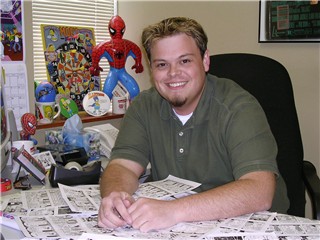

Artist Statement:
BRAD K. CAMPBELL
When asked what kids want to be when they grow up, most respond with your average kid fantasy jobs: baseball player, astronaut, ballerina, professional wrestler, etc. I was the only kid in my fifth grade class who wanted to be a syndicated cartoonist (or for that matter knew what one was). I taught myself how to draw by reading the Sunday comics. every Sunday, I would pull out my trusty drawing tablet and draw my favorite characters. At ten years old, I had created my own comics page featuring five different original comic strips. At eleven years of age, I had created my own original character, Slick the Dog, and he appeared in 25 books which I wrote and illustrated for ten years throughout my high school career. At the same time, I created a weekly comic strip for my high school newspaper called Tiger Stripe, featuring the school mascot. As if two comic strips (and puberty) weren't enough, I created a third strip, Boswald T. Bass, which followed the adventures of boswald and his underwater friends.
In my sophomore year of college, I noticed that the Almagest (the campus newspaper), did not have a comic strip. This inspired me to create Roofus©, a comic strip about college life as seen through the eyes of a dog. After attending college for two years, I was overflowing with ideas that I wanted to express based on my personal life and college experiences. I presented my comic strip to the college newspaper and the editor loved it. Roofus was published every week in the Almagest and I was finally a published cartoonist.
Things have come full circle. Currently, Roofus is published on a daily comics page and weekly in 18 different newspapers. My childhood fantasy has become a reality. With any luck, Roofus will become nationally syndicated and I will be able to share my dream with the world. If not, there's always professional wrestling.
Brad Campbell is a native of and is currently employed as a Graphic Designer at Graphic Industries and SB Magazine.

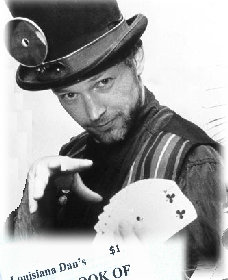

Visit Dan's websites!
- View his ArtBlog: http://dangarnerart.blogspot.com/
- For Louisiana Dan: http://louisianadan.blogspot.com/
- To hear tunes: http://www.myspace.com/louisianadan
- For a listing of gigs: http://dangarner.blogspot.com/
Tipitina's aims to help musicians grow their business
April 12, 2005
By Alexandyr Kent
Having success as a musician is not just about playing good music; it's also about building a bigger market for it.
That's the basic premise behind Tipitina's Music Office Co-Op/Shreveport, a nonprofit business incubator that will open Friday at 700 Texas St. in downtown Shreveport.
For a $10 monthly fee, musicians and digital media-makers (including filmmakers and photograhers) can gain access to and training on computers, the Web, fax machines, copy machines, and word-processing, digital media and Web-design software.
"The goal of the co-op is very simple: to put more money in the pockets of musicians and other media professionals," said Todd Souvignier, head of operations for Tipitina's Foundation. "How we do that ranges from helping them get e-mail, getting them on the Web, getting press kits together ... ."
Regular office hours will be 10 a.m. to 6 p.m. Monday through Friday. Phone lines are being hooked up Wednesday: (318) 934-0000.
Tipitina's Foundation has already established a co-op with the legendary New Orleans club. Souvignier released a economic impact survey in 2004 which demonstrated significant benefits for members.
"We've repeatedly shown about a 30 percent increase in musician earnings as a direct result of participating in the co-op (in New Orleans)."
Dan Garner, an experienced local musician, has been hired to manage the Shreveport co-op. He believes it will open up new opportunities for local musicians and media-makers.
"This incubator makes them think of it as a real business," he explained. "It make them think about the possibilities of things like licensing, publishing, and copyright."
Souvignier said market realities require musicians to work harder to be successful. "The idea of sending a demo to Warner Brothers and getting a deal, those days are over. This is the era where you need to finish your product and release it yourself and create a track record for yourself. Once you've marketed yourself, then maybe major labels will come to you."
Shreveport's Downtown Development Authority has already earmarked $40,000 to support Tipitina's. Janie Landry, DDA's deputy director, said the co-op fits into their efforts to strengthen the West Edge Arts District. "From our standpoint, the music co-op will be a great addition to the West Edge and will benefit musicians in the Shreveport and Bossier area," she said.


Artist's Statement
Intimately, and uniquely connected to the evolution of Louisiana culture, my place is defined by my heritage as the son of a Baptist preacher, refined by the academic environment of a small southern college town, and expanded by the power of imagination, creativity, talent, and desire.
I was blessed with the gifts of musical and artistic talent combined with a desire to explore, and express myself in this paradise of senses, emotions, thoughts, and feelings. I collect ideas, images and objects that I am drawn to, or that come to me naturally, these things eventually make their way into a musical or visual composition that symbolizes events, concepts, feelings, or moments of personal enlightenment. My art emanates from a cerebral space where the imagination muses on my relationship to these objects, symbols, sounds, people, and feelings - eventually, the proper arrangements reveal themselves to me during the process. For me, the process of making art or music is rarely premeditated, it is usually the result of how I am experiencing my life at the time of producing the work. Consequently, I never produce a work with the intention of selling it, I will not do commissions, I will not interrupt my personal artistic journey to create something without pure meaning for me. All of my work is about relationships. Collaborations with other artists are the result of relationships. My music is the product of relationships expressed in a form that relies entirely on relationships of timing, tone, texture, velocity, volume, attitude, lyric, emotion, and movement. In performance, the relationships in the music itself are amplified through a relationship with an audience of thinking, feeling, dreaming individuals - for a moment, sometimes, we share a consciousness. I find that visual art is exactly the same. There, in static form is a series of events or objects arranged into an image expressing a thought, emotion, or situation. Ultimately, I gravitate toward any arrangement that expresses a union of opposites - spiritual & temporal, pleasure & pain, innocence & guilt, action & reaction all are part of our life process in keeping with this universe of order & chaos, mystery and wonder.
My work is autobiographical, it is the result of being involved in the process of living, and striving for a clearer consciousness. I have given myself to over to expressing myself, and sharing in the artistic journeys of others. I have made myself available, and open, and have been blessed by having been a part of improving the quality of life for myself and others right here in Louisiana.
Alan Dyson turns imagination loose
April 29, 2005
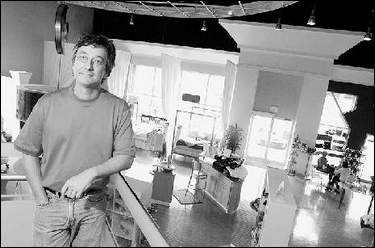
Freelance artistic designer Alan Dyson had a hand in designing Prima Tazza at Ashley Ridge Pointe. (Robert Ruiz/The Times)
By Jennifer Flowers
Whether Alan Dyson is solving a conceptual design problem or composing the notes to a song, he's just thankful he has an excuse to use his imagination.
For the artist, letting the mind wander freely is the real jazz of art.
Dyson, a Ruston native, studied architecture at Louisiana Tech and ended up graduating instead with a bachelor of fine arts when he discovered math wasn't his bag. He worked at Brown Builders Inc., for nearly 25 years, starting as a draftsman and then working his way to director of design for the company's design-build projects. He also had a hand in designing the Ashley Ridge Pointe complex, Fernwood Plaza and most recently the Shoppes at Bellemeade, a lifestyle shopping center still in its final stages of completion.
But architectural design isn't the only medium that sates his creative appetite, and perhaps that's why he was the recipient of the Shreveport Regional Arts Council's Multidisciplinary Arts Fellowship in 1999. A lover of the human figure, Dyson sketches nudes. He also composes music and hosts the Red River Radio "House Concert Series."
QUESTION: You've dabbled in a lot of different creative art forms. How do they relate to each other?
ANSWER: To me, architecture is the same thing as doing a painting, as writing a song. The processes are very similar. In architecture you have a visual rhythm you're setting up with visual art. If it's just visual art, you're setting up an arrangement of shapes that people can respond to. The same thing happens with music. In music you're playing with the mood and rhythms and tones.
Q: What's it like to use architecture as an artistic medium?
A: In architecture you're playing with structure, colors, shapes and spaces. You're playing with environments, and it takes in all sorts of considerations. It's a multi-layered effort because you've got to think about electricity and plumbing and air conditioning.
Q: What do you like about architecture?
A: Architecture is like the perfect type of sculpture. It's a sculpture you get to walk around inside of, in between and under. It's also a very collaborative art because you're not off in some room somewhere by yourself doing something. You have to collaborate with the owner, who has a need in the first place. You have to collaborate with a design team, which consists of architects and engineers and a myriad of consultants.
Q: What do you like about visual art?
A: Consequently, it's the stuff that people don't like to buy. The idea there is to create an image that's so strong it sticks with you and goes home with you, whether you take it home or not.
Q: Describe your architectural design style.
A: I like contemporary looking stuff. I appreciate traditional stuff, and usually what I do has a nod to traditional forms. I like things to look like they're well balanced and structurally sound. You don't want it to be spindly looking. Like some stuff looks like it's been built by toothpicks and it's about to fall down. That makes me nervous.
Q: What do you think about the current state of local architecture?
A: I think it's a drag. We have some really wonderful architecture that is sadly crumbling right in front of us. "» It's just so expensive to bring these structures up to code, and so many of them are just so far gone, it's just shocking. But some of the new architecture that's going up, I really enjoy. I really like the downtown riverfront project with the water fountains -- that's really cool. The new (J. Bennett Johnston Waterway Regional) visitor center is spectacular. The new addition to Sci-Port is going to be incredible. Some really nice cutting-edge stuff is being done.
Q: Tell me about your nude drawings.
A: I was intimidated by nudes for a long time when I went to college. To me it was the hardest thing to ever draw. You've got all these nuances. The human body -- you talk about perfect architecture, there you go. "» you can render a thing as an object or you can render a thing as a being, and that's the hardest part. And you just have so much to work with. I could draw feet and that would be plenty to keep me busy for a long time.
Q: What makes good art?
A: It has to have a sense of being right. It has to have a sense of being the best it could possibly be. The best analogy I can think of right now is the Olympics. When you see someone doing what they do and they're at the top of their game and it's obvious, that's it. The reason I'm really thankful right now about what I've gotten to do in architecture is I'm as close as I can be to being on top of my game right now.
Q: What's been the best part of being an artist?
A: The thing I like the best about what I've been able to do is the relationships I've been able to build with other artists and architects and musicians and poets. It makes me want to smoke my pipe and philosophize.